
Japan Considers Website Blocking as Illegal Online Gambling Cases Surge
A Japanese government panel has moved closer to supporting the use of website blocking as part of the country’s strategy to combat illegal online casinos, even as it acknowledges potential conflicts with constitutional protections.
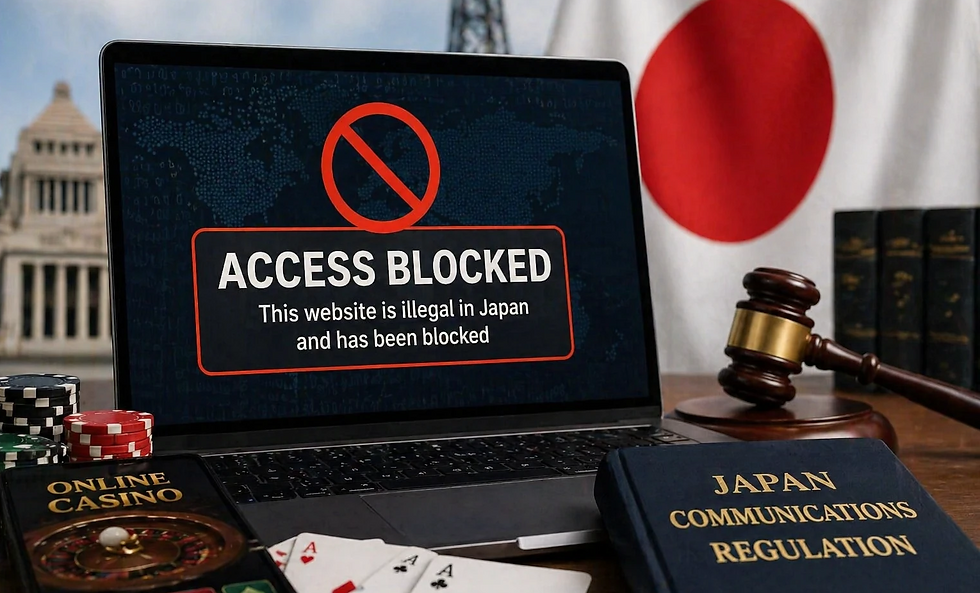
The discussion emerges at a time when enforcement actions tied to unlawful online gambling have reached their highest level in years.
The panel, convened under Japan’s Ministry of Internal Affairs and Communications, stated in a draft report that restricting access to online casino websites could be an effective enforcement tool.
However, it also emphasized that such an approach raises complex legal and constitutional concerns. Rather than presenting blocking as a standalone solution, the panel framed it as one component of a broader policy approach aimed at limiting access to illicit operators while reducing gambling-related harm.
According to the draft, the effectiveness of blocking measures “cannot be denied,” highlighting a growing openness among policymakers to consider stronger digital interventions. At the same time, the panel warned that implementing such restrictions could interfere with constitutionally protected rights, including the secrecy of communications and access to information.
Because of these concerns, the panel stopped short of endorsing immediate or unrestricted deployment of website blocking. Instead, it argued that authorities should first evaluate whether less intrusive measures have been fully exhausted before turning to such actions.
This position underscores the importance of proportionality in the debate, suggesting that any implementation of blocking would need to be justified as a last-resort option rather than a default enforcement mechanism.
The draft also ties the issue to Japan’s revised basic law on gambling addiction, which came into force in September of last year. Within this framework, measures targeting online casinos are expected to complement broader policy initiatives rather than rely on a single technical fix. The panel pointed to tighter advertising controls and other efforts designed to reduce public exposure to illegal gambling services as part of this coordinated approach.

This reflects a wider regulatory philosophy that combines demand-side prevention with supply-side restrictions. For the iGaming industry, this is significant, as it mirrors trends seen in other jurisdictions where regulators increasingly deploy a mix of consumer awareness campaigns, advertising limitations, and digital access controls to address unlicensed operators.
The panel’s findings were released amid a sharp rise in enforcement activity. In 2025, Japan recorded its highest number of cases related to illegal online gambling since 2018, underscoring the growing priority of the issue for authorities.
This surge has added urgency to the policy debate, as officials explore whether disrupting access at the website level could more effectively curb the reach of offshore casino platforms.
Despite this increased enforcement pressure, the report makes clear that legal considerations remain central. Even with the rise in cases, policymakers must carefully balance efforts to maintain public order with the need to uphold constitutional safeguards.
At this stage, the panel has not positioned website blocking as an immediate policy directive. Instead, its draft outlines the conditions under which such measures might be introduced, emphasizing the need for necessity, proportionality, and coordination with other anti-gambling initiatives.
As the discussion progresses, the focus in Japan is expected to shift from whether blocking is effective in principle to whether it can be implemented within existing legal constraints. For international stakeholders in the gambling sector, the development signals increasing scrutiny of digital channels used by unlicensed operators across Asian markets.
Should Japan ultimately move forward with website blocking, the implications could extend beyond enforcement metrics, potentially affecting affiliate marketing practices, advertising regulations, and the broader treatment of offshore gambling access.
By fLEXI tEAM


Comments