
CBC Launches New Blog as Economists Warn High Prices Persist Despite Inflation Slowdown
The Central Bank of Cyprus has unveiled the CBC Blog, a new digital communication platform designed to deepen public understanding of economic developments and the role of central banking. The initiative, according to the bank, is part of a broader strategy to strengthen transparency and improve the flow of information to the public regarding economic conditions and monetary policy.
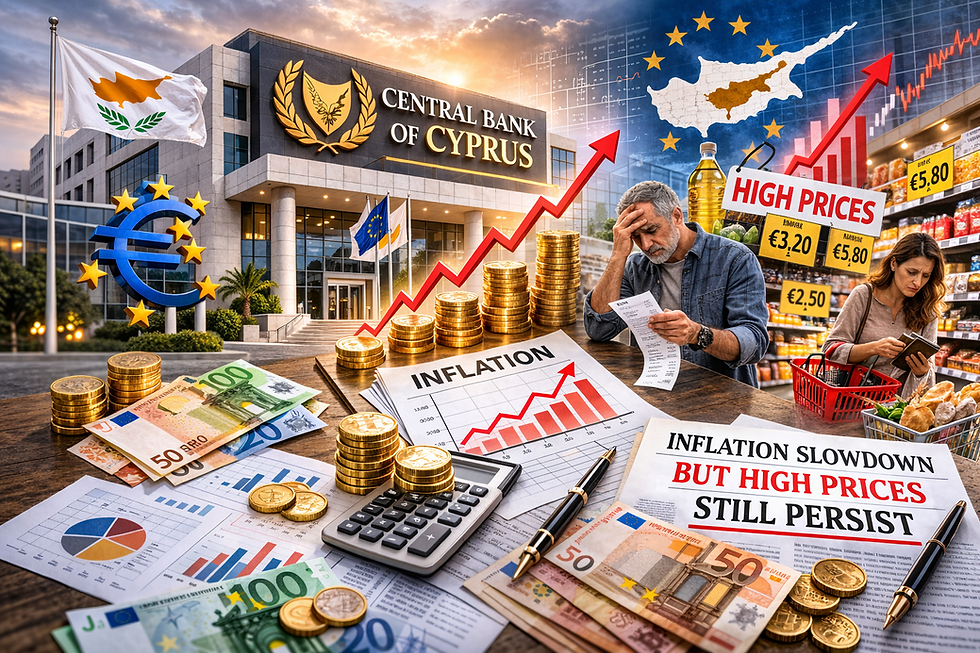
Through this newly established blog, the central bank aims to publish timely, accessible and analytically rigorous commentary on issues related to the economy, financial stability, monetary policy and central banking more broadly. The platform will host technical, signed contributions written by members of the institution’s staff, drawing on their professional expertise and experience within the central banking system. The CBC stated that its objective is to provide credible, thoroughly documented and comprehensible information not only to specialists and journalists, but also to the wider public.
The inaugural post focuses on inflation developments in Cyprus, examining recent dynamics and longer-term trends. The article was authored by Demetris Kapatais, Maria Mithillou and Maria Papageorgiou, three officials of the central bank. In their analysis, they caution that although inflation has decelerated sharply, elevated prices continue to weigh heavily on households and erode purchasing power.
Reviewing the period from 2019 to 2025, the authors conclude that the cumulative increase in prices over recent years remains a significant burden, particularly for vulnerable segments of society. They note that the rising cost of living has become one of the most urgent concerns in both Cyprus and across Europe, referencing findings from the Eurobarometer survey published in February 2026. According to that survey, 41 per cent of European citizens identified combating inflation, high prices and the cost of living as the European Parliament’s top priority, while 34 per cent of Cypriot respondents considered the issue equally significant.
The economists emphasise that high prices, especially in essential goods and services, are directly linked to inflation and have an immediate impact on households’ real purchasing power. They underline that lower-income and vulnerable households are disproportionately affected, as they have less flexibility to absorb rising expenses.
Their study concentrates on private sector wages, deliberately excluding public administration, education, health and the information and communication sector. The authors explain that public sector wages are largely determined by institutional pay scales, while the technology sector exhibits substantial wage dispersion that could distort broader comparisons.
Clarifying the conceptual difference between inflation and high prices, the authors explain that inflation measures the pace at which prices rise within an economy, whereas high prices refer to the relationship between the general price level—particularly for essentials such as food, energy and housing—and income levels. “When inflation is high or a wave of price increases has preceded, high prices are strongly felt, even if later the rate of price increases slows,” the authors state. They further observe that elevated price levels can persist even during periods of low inflation if essential goods and services have already climbed to levels that are disproportionately high relative to incomes.
Between 2021 and 2024, cumulative inflation in Cyprus, as measured by the Harmonised Index of Consumer Prices, reached 16.5 per cent, while in the euro area it climbed even higher to 18.8 per cent. The authors attribute this surge primarily to strong inflationary pressures triggered by external shocks, notably the effects of the Covid-19 pandemic and Russia’s invasion of Ukraine, compared with pre-pandemic conditions.
By 2025, inflation in Cyprus had slowed markedly to 0.8 per cent, significantly below the European Central Bank’s medium-term target of 2 per cent. In the euro area, the corresponding rate stood at 2.1 per cent. Despite this sharp deceleration, the authors warn that the slowdown does not resolve the issue of high prices, as the cumulative increases since 2019 have left the overall price level substantially elevated.
Turning to wage developments, the analysis finds that over the long term, wage growth has been closely linked to both inflation and productivity. Between 1997 and 2010, wages rose broadly in line with productivity growth, which averaged around 1.5 per cent, while inflation remained above 2 per cent, partly reflecting VAT increases linked to European harmonisation. However, during the economic crisis from 2012 to 2015, this relationship broke down. Wages were cut and no cost-of-living allowance was granted amid negative economic growth and deflation.

In the more recent period between 2020 and 2024, wages increased by approximately 2.9 per cent annually, amounting to a cumulative rise of 14.5 per cent. Over the same timeframe, inflation averaged 3.1 per cent per year, or 15.4 per cent cumulatively. This near-parallel movement underscores the pressure households faced as wage gains struggled to keep pace with rising living costs.
The authors further highlight that price pressures have been particularly acute in categories representing the largest share of household expenditure, especially for vulnerable groups. Overall, the Harmonised Index of Consumer Prices in 2025 stood 17.1 per cent higher than in 2019.
Energy prices in 2025 were 26.1 per cent above 2019 levels, with electricity up 41.9 per cent, diesel up 18 per cent and petrol up 15.2 per cent. Food prices rose by 19.2 per cent over the same period. Within this category, bread and cereals increased by 20.9 per cent, dairy products including cheese by 17.9 per cent, mineral waters and soft drinks by 28.8 per cent, pork by 32.4 per cent, fruit by 41.2 per cent and vegetables by 15.9 per cent.
Services prices climbed by 19.1 per cent compared with 2019. This rise was driven largely by tourism-related services, with hotel prices up 26.2 per cent, restaurants and cafes up 28.4 per cent and organised holiday packages surging by 45 per cent. Rents increased by 21.7 per cent and education fees by 11 per cent.
Industrial goods excluding energy recorded a more moderate increase of 6.5 per cent. Within this segment, car prices rose by 21.5 per cent, furniture and decorative items by 14.8 per cent, pharmaceuticals by 7.6 per cent and personal electrical appliances by 5.1 per cent. By contrast, clothing prices declined by 0.4 per cent and footwear fell by 6.7 per cent.
The authors note that targeted government interventions helped mitigate some of the inflationary impact. Internal calculations indicate that annual inflation was reduced by around 0.6 percentage points in 2022 and 0.4 percentage points in 2023 due to measures affecting fuel and electricity prices. In 2024, a zero VAT rate applied to certain food categories lowered annual inflation by a further 0.3 percentage points.
They also point out that businesses absorbed part of the cost pressures by compressing profit margins, which averaged slightly negative levels close to minus 0.5 per cent between 2022 and 2024, thereby contributing to price stabilisation.
In their concluding remarks, the authors stress that durable solutions require coordinated action. “Addressing high prices requires a combination of targeted state and private sector interventions that strengthen disposable income of low-paid households without undermining competitiveness and fiscal discipline,” the authors conclude.
By fLEXI tEAM


Comments